
Eye Exam vs. Vision Screening: What Is the Difference and Why Does It Matter?
Most people have had a vision screening at some point. The school nurse holds up a chart. You cover one eye and read the letters. You pass, you go back to class, and the assumption settles in that your eyes are fine. That assumption is one of the most common misconceptions in preventive healthcare. A vision screening and a comprehensive eye exam are fundamentally different in scope, in what they can detect, and in what they can protect you from. Understanding that difference is not just an academic exercise. For the growing communities of North Dallas and Plano, where busy schedules and general good health can create years-long gaps in professional eye care, the distinction between a screening and a true exam can be the difference between catching a serious condition early and missing it entirely. The Plano Eye Care Center, provides the kind of thorough, technology-driven comprehensive eye care that a screening simply cannot replicate. Here is exactly what sets the two apart.
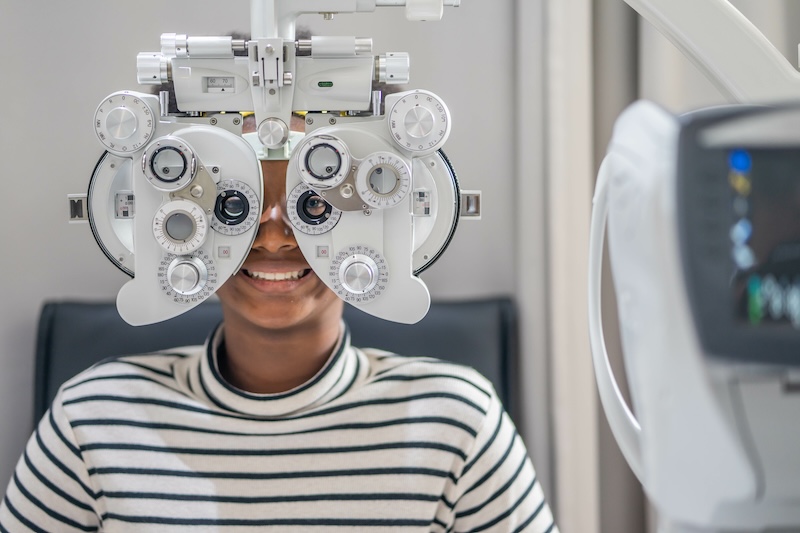
What a Vision Screening Actually Tests
A vision screening is a limited pass-or-fail check designed to identify one specific problem: whether a person’s distance visual acuity falls below a threshold that suggests they may need corrective lenses. The familiar wall chart, known as a Snellen chart, has been the standard screening tool for over 150 years. It measures how clearly you can see at a fixed distance under controlled conditions.
Vision screenings are conducted in schools, at the DMV, during pediatric wellness checkups, and at health fairs. They are performed by school nurses, volunteers, pediatricians, and other non-eye-care professionals. They serve a meaningful public health function by flagging children and adults who may need glasses and who might not otherwise seek care. But their limitations are just as significant as their value.
A screening cannot detect glaucoma. It cannot identify diabetic retinopathy. It cannot reveal early macular degeneration, cataracts in development, or high ocular pressure that precedes vision loss. It cannot evaluate the health of the retina, the optic nerve, or the internal structures of the eye. It cannot diagnose dry eye disease, binocular vision disorders, or the early signs of systemic conditions like hypertension and diabetes that often manifest in the eye before they are detected elsewhere in the body. Perhaps most critically, a vision screening can be passed by someone whose eyesight is currently adequate for distance tasks but who has significant eye disease developing behind clear vision.
What a Comprehensive Eye Exam Actually Involves
A comprehensive eye exam at The Plano Eye Care Center is a thorough clinical evaluation of both visual function and ocular health. It is conducted by a licensed optometrist using diagnostic equipment designed to assess structures and conditions that are completely invisible to a screening.
Visual Acuity and Refraction
The exam does begin with visual acuity testing, which is the element most people recognize from screenings. But where a screening stops at a simple pass-or-fail result, a comprehensive exam uses a full refraction process to determine the precise prescription that provides the clearest possible vision at all distances. Near, intermediate, and far vision are all evaluated, and the results account for the full complexity of each patient’s refractive needs.
Ocular Health Evaluation
This is where a comprehensive exam moves into territory a screening cannot touch. The Plano Eye Care Center uses state-of-the-art diagnostic technology to evaluate the health of the cornea, lens, retina, optic nerve, and surrounding structures. Instruments that measure intraocular pressure help identify elevated pressure associated with glaucoma. Retinal imaging provides a detailed view of the back of the eye that can reveal early signs of diabetic changes, macular degeneration, retinal tears, and vascular abnormalities. Slit-lamp examination of the anterior structures of the eye allows the doctor to assess the cornea, iris, and lens in detail that no screening tool approximates.
Binocular Vision and Eye Coordination
Many vision problems involve how the two eyes work together rather than the clarity of vision in each eye independently. Eye teaming, tracking, and focusing disorders can cause symptoms including headaches, eye strain, difficulty reading, and fatigue that are entirely missed by a standard acuity screening. A comprehensive exam evaluates these functions and can identify issues that explain chronic symptoms patients have often attributed to other causes.
Detection of Systemic Health Conditions
The retina is the only place in the body where blood vessels can be observed directly and non-invasively. This makes a comprehensive eye exam one of the few routine health evaluations capable of detecting vascular changes associated with hypertension, diabetes, high cholesterol, and other systemic conditions. Optometrists regularly identify findings during eye exams that prompt patients to follow up with their primary care physician for conditions that had not yet been diagnosed. In a community like North Dallas and Plano, where demanding work schedules can compress the time people spend on preventive health care, this aspect of a comprehensive exam carries real weight.
How Often Should You Have a Comprehensive Eye Exam?
The American Optometric Association recommends comprehensive eye exams every one to two years for adults, with annual exams for anyone over 60, anyone with diabetes or a family history of eye disease, and anyone who wears contact lenses. Children should have their first comprehensive eye exam at six months, again at age three, and before starting school, with regular exams throughout the school years. A vision screening at school does not substitute for any of these.
The Plano Eye Care Center sees patients of all ages, from pediatric vision evaluations for children navigating the demanding academic environment of North Texas schools to senior vision care, dry eye management, specialty contact lens fittings, glaucoma monitoring, and co-management of LASIK procedures. The BBB A+ rating the practice holds reflects years of patient-centered care and the kind of trust that builds over time in a community that takes its health seriously.
The Bottom Line
Passing a vision screening means your distance visual acuity met a minimum threshold on that day. It does not mean your eyes are healthy. It does not mean you do not need glasses. And it does not substitute for the professional evaluation that can catch the conditions most likely to cause permanent vision loss before they have the chance to progress.
A comprehensive eye exam is the standard of care. A vision screening is a starting point, and often a false finish line.
Ready to Schedule a Comprehensive Eye Exam? Contact The Plano Eye Care Center Today.
Serving patients throughout Plano and North Dallas, The Plano Eye Care Center combines advanced diagnostic technology with experienced, personalized optometric care. Contact us to schedule your appointment.